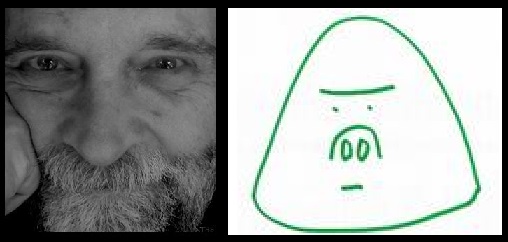
Okay, I give up. You’ve convinced me.
1
2
Of what?
1
2
3
That control addiction is my biggest problem.
1
2
What did it?
1
2
3
Last session.
1
2
3
therapist-3
1
2
3
Afterwards I realized that I really do feel like I’m always walking six dogs at once.
1
Good.
1
2
3
So what do we do now?
1
2
3
Controlapy.
1
2
3
What’s that?
1
2
Control therapy. My nickname for it.
1
2
3
“Controlapy”? That’s stupid.
1
2
Yes. But catchy.
1
2
3
And I suppose that makes you a…
1
2
Controlapist.
1
2
3
(Sigh.)
1
2
3
therapist
1
2
3
And what does “controlapy” involve?
1
2
Learning three things.
1
2
3
bert-11
1
2
First, what control addiction is and how it infects all of us.
1
2
3
bert
1
2
Second, where you personally have problems with compulsive controlling.
1
2
3
bert-13
1
2
And finally, how to replace control addiction with healthier coping methods.
1
2
3
And you set the agenda?
1
Mostly I react to what you bring in. But I decide which sort of learning we need to focus on.
1
2
Isn’t that, well, controlling of you?
1
2
I suppose.
1
2
3
bert-16
1
2
3
But also controlapeutic.
1
2
3
bert-17
* * *
The idea of control controls the controllers; we are not in control of the power of control.
~ James Hillman, Kinds of power: A guide to its intelligent uses (Doubleday, 1995).
x
Addiction, to anything, is always searingly narcissistically injurious. Something else has power over the self; feelings of shame, humiliation,and guilt are ineluctable. That’s saying too little. The self-hatred of the addict is the essence of his problem. Feeling powerless, he or she can only recover through a paradoxical admission of powerlessness — powerlessness over the addictive substance or activity.
~ Jerome David Levin, Slings and arrows: Narcissistic injury and its treatment. (Jason Aronson, 1993).
x
We want to be more alive and feel more, but we are afraid of it. Our fear of life is seen in the way we keep busy so as not to feel, keep running so as not to face ourselves, or get high on liquor or drugs so as not to sense our being. Because we are afraid of life, we seek to control or master it.
~ Alexander Lowen, Fear of life (Collier Books, 1980).
* * *
“Should I worry?”
Concerned about someone’s drinking, but not sure if you should be?
Check out Crossing the Line:
And what is this “line?”
It represents the three stages of drinking briefly described below:
• Alcohol Use = “low-risk” or moderate drinking [Myth 1]
• Alcohol Abuse = repeated binge drinking and/or routine heavy social drinking [Myth 9]
• Alcohol Dependence = alcoholism, one of the brain diseases of addiction [Myth 10]
Most people are unaware there is a line comprised of these three stages of drinking, believing instead that drinking is either “normal” or “alcoholic.”
Most people are unaware there are increments along the line itself, that 35% of American adults never drink alcohol, or that 37% of American adults always drink within “low-risk” drinking limits.
Thus examining and challenging the common myths from a scientific perspective can help readers recognize what it takes to cross the line from alcohol use to abuse to dependence and what it takes to stop the progression.
~ Lisa Frederiksen, Crossing the Line
Author of nine books, including Loved One In Treatment? Now What! and If You Loved Me, You’d Stop!, Lisa Frederiksen is a national keynote speaker with 25 years experience. She has been consulting, researching, writing and speaking on substance abuse, addiction, education, prevention, intervention, treatment, dual diagnosis, underage drinking, and help for the family centered around 21st century brain and addiction-related research since 2003. Check out her website Breaking the Cycles.
![[] ps w fist & dark green](http://monkeytraps.files.wordpress.com/2012/03/ps-w-fist-dark-green.png?w=490)


![[] Bert's blackboard (3) ~ Welcome to Monkeytraps 101](http://monkeytraps.files.wordpress.com/2012/04/berts-blackboard-3-welcome-to-monkeytraps-101.png?w=300&h=189)